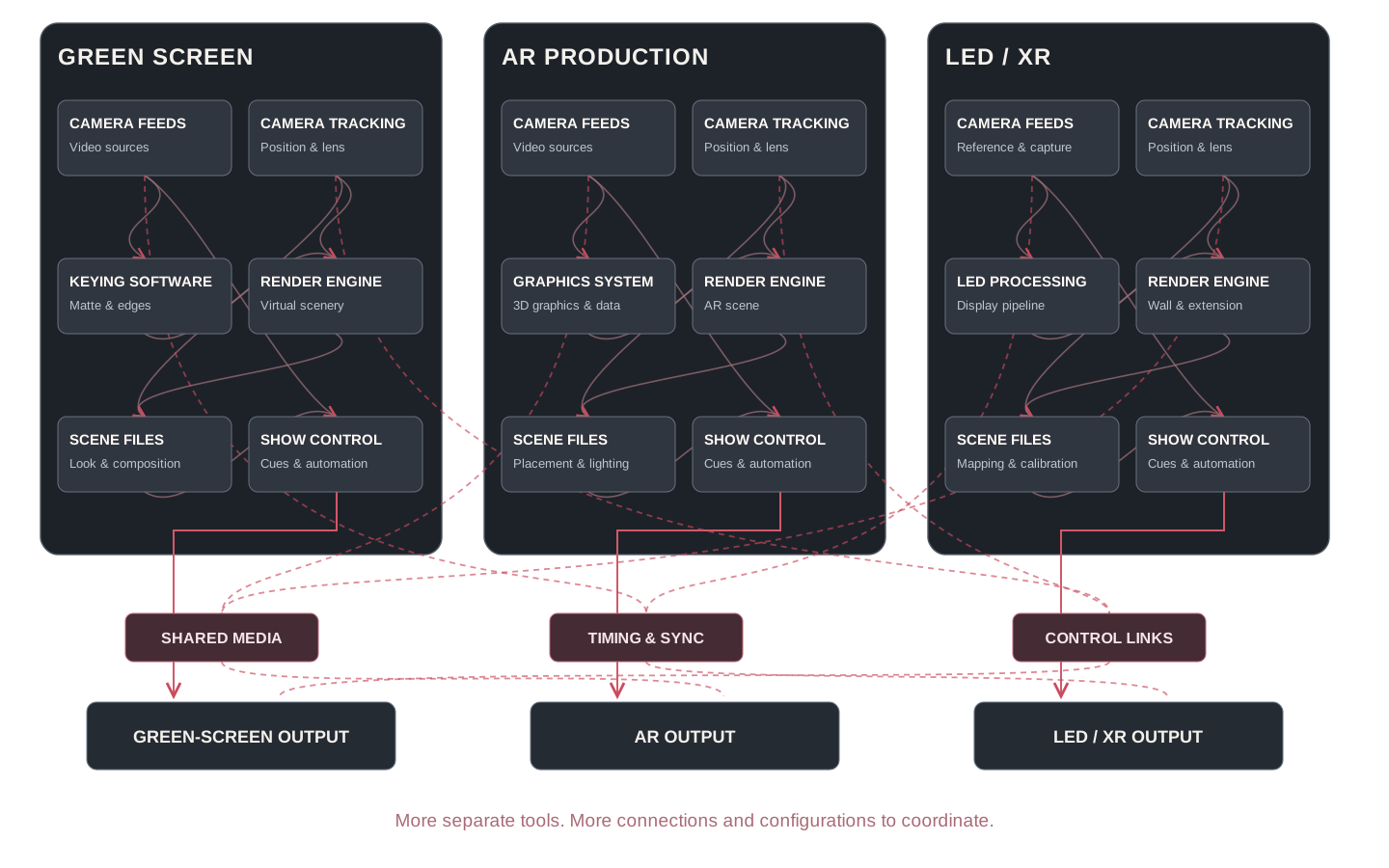
Different formats can become separate production systems
A green-screen programme, an AR presentation and an LED production have different ways of creating the final picture. When each is built around a separate rendering and control setup, moving between them can mean changing machines, loading another environment and preparing the show again.
That separation adds equipment and operational work. For a studio producing several kinds of programme, the question is whether each format really needs its own engine and a different way of working.
Prepare the productions as profiles
Wyvern brings green-screen, AR and LED production into one engine and a shared operating workflow. Profiles store prepared production setups, bringing the scene, composition and relevant settings together so the operator can recall the next picture.
A profile can represent a green-screen virtual studio, while another represents an AR shot or an LED production setup. The operator works with the same system and organised production data across those formats.
Change the production with a live cut
Once the profiles and required sources are prepared, switching format becomes part of operating the show. Preview the next profile, check its complete result and take it live with a hot cut. The next profile can use a different production format within the same running engine.
This lets a programme mix approaches: a presenter can appear in a green-screen virtual set for one segment, followed by an AR presentation or an LED-based shot. The team recalls a prepared production instead of treating every change as a move to a separate rendering system.
One engine across the daily schedule
The same approach also works between shows. A green-screen programme from 3–4 p.m. and an LED production from 5–6 p.m. can use the same Wyvern engine, with each show’s setups stored as profiles. The next production reuses the system and its operating workflow.
Keeping prepared scenes, graphics and settings within one workflow reduces duplicated setup work and makes it easier to return to a show’s established look. The crew can organise production around the schedule rather than assigning a separate engine to every format.
Where the cost and operating benefits come from
Sharing one engine across supported formats can reduce the need for separate rendering computers and repeated configuration. The team also learns one control environment, retains its prepared production data and uses the same preview-and-take process during live operation.
The physical setup still follows the picture: green screen needs an appropriate keying space, LED needs its display system, and camera tracking and sources need to be configured for the planned shots. Wyvern unifies the engine and operating workflow around that equipment. Prepare those dependencies in advance, then use profiles to move between the productions.